Each group developed an object by applying technical and social criteria: accessibility, production efficiency, clear documentation, and responsible use of resources. Thereafter, they tested the scalability of their proposals using the Replicability Index, a methodology for measuring the ease with which a design can be reproduced in other environments.
This approach allowed the students not only to refine the prototypes but also to understand how their decisions will affect the cost, time, and experience of those who plan to replicate their designs. The opportunity to share these projects with other laboratories in the Fab Lab network added a global component that enriched learning and opened up new perspectives on the role of distributed design in contemporary innovation.
The workshop was integrated seamlessly into the degree program-s educational approach, in which students are encouraged to experiment with cutting-edge technologies, develop critical thinking, and work in collaborative environments connected to real-life challenges. The combination of digital fabrication, open documentation, and project-based learning strengthened participants' essential technical competencies while allowing them to cultivate skills such as adaptability, creativity, and the ability to work in global communities of practice.
These experiences contribute to a form of learning in which design is understood as an open, interactive, and impact-oriented process, and where students can explore—through practice—how their ideas can be transferred, evolve, and create value beyond the classroom.
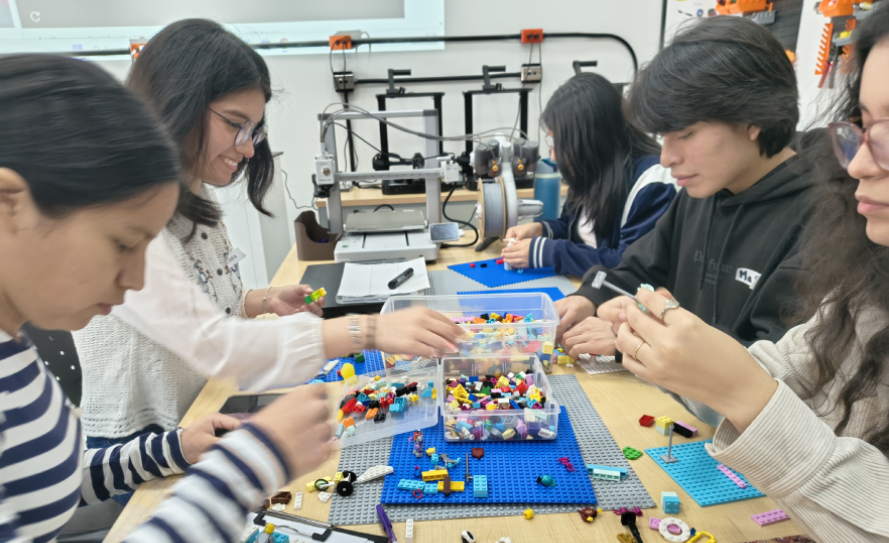
For Mario Chong, Vice Dean of Innovation and Design Engineering, the activity reflects the spirit of the degree program: "We want our students to understand that design takes on new meaning when it is open, replicable, and designed for different contexts. This workshop allows them to experiment with technologies that transform ideas into real prototypes and connects them with a global community that continually shares, improves, and reimagines solutions. ”
The Distributed Design Workshop reaffirms the Universidad del Pacífico's commitment to training that combines technical rigor, innovation, and purpose. This collaboration with Fab Lab Perú gave students an experience that broadened their perspective on design and engineering, strengthening their ability to create sustainable, scalable solutions aligned with the needs of an environment that demands openness, interdisciplinarity, and global vision.